COGNIRON Project
Videos
(2006)
 |
 .MPG .MPG |
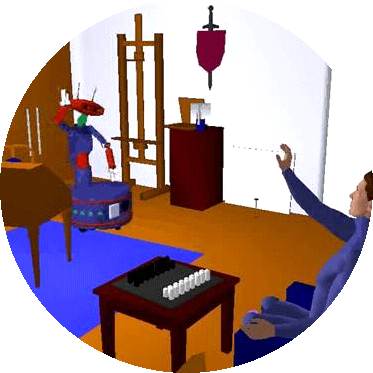
'The Cogniron Vision' (.mpg - 5MB) |
The overall objectives of this project are to study the perceptual, representational, reasoning and learning capabilities of embodied robots in human centred environments. The project will develop methods and technologies for the construction of such cognitive robots able to evolve and grow their capacities in close interaction with humans in an open-ended fashion.
The project is structured along 6 Research Activities (RAs) and three Key Experiments (KES).
The latest project results are illustrated for each part of the project below, through the most recent videos.
More detailed information can be found on our pages under www.cogniron.org .
RESEARCH AREA 1 - Multimodal Dialogues (Top)
(lead partner: University of Bielefeld)
Using language to communicate with others is
one of the most important cognitive abilities of
humans. Enabling dialogue capability is, therefore,
essential for a cognitive robot companion
interacting with humans . Since a robot is embodied
and situated in the real environment, its
dialogue system has to handle more complex
interactions than in human computer interaction.
One of the crucial aspects is the handling of
multi-modality because in embodied communication
human interlocutors make heavy use of
gestures and other non-verbal signals and make
references to the shared environment. Building a
flexible dialogue system with the ability to handle
multi-modal information and continuously
evaluating the system during the different development
cycles are the focus of this research
activity.
 |
.MOV |
RA1_HelloHuman_Run21#12BADE.mov (Univ. of Bielefeld) | |
 |
.MOV |
RA1_ILostYou2.mov (Univ. of Bielefeld) | |
 |
.MOV |
RA1_WhatColorItIs_Ru#12BADC.mov (Univ. of Bielefeld) |
RESEARCH AREA 2 - Detection and Understanding of Human Activity (Top)
(lead partner: University of Karlsruhe)
Detection and understanding of human activities
is a basic capability of a robot acting in close
cooperation with humans. This research activity
deals with visual detection and tracking of
human faces, which is one important component
of this capability. Another studied component is
3D modeling of human body for detection and
recognition of postures, and the interpretation of
human activities based on gesture, postures,
attitudes, and motions.
 |
.AVI |
ActiRec138MB.avi (Univ. of Karlsruhe) |
 |
.MPG |
croisement.mpg (LAAS-CNRS) |
 |
.MPG |
fondencombreFIM2.mpg (LAAS-CNRS) |
| .MPG |
Fusion10MB.mpg (LAAS-CNRS) | |
 |
.MPG |
GROUPE2.MPG (LAAS-CNRS) |
 |
.MPG |
main-config-encombre-F.mpg (LAAS-CNRS) |
 |
.MPG |
main-config-encombre-FC.mpg (LAAS-CNRS) |
 |
.MPG |
main-dynamique.mpg (LAAS-CNRS) |
 |
.MPG |
occultationciblestatique-ICOND.mpg (LAAS-CNRS) |
 |
.MPG |
occultation-ICOND2.mpg (LAAS-CNRS) |
 |
.MPG |
proche-suiviautreindividu-FIDM.mpg (LAAS-CNRS) |
 |
.MPG |
proche-suiviavecsaut-FIDM.mpg (LAAS-CNRS) |
 |
.MPG |
proche-suivichgapp.mpg (LAAS-CNRS) |
|
.MPG |
proche-suivinormal.mpg (LAAS-CNRS) |
 |
.MPG |
proche-suivioccultation-FIDM.mpg (LAAS-CNRS) |
 |
.MPG |
proche-suivivariation.mpg (LAAS-CNRS) |
 |
.AVI |
run1display.avi (Univ. of Karlsruhe) |
 |
.AVI |
run1displayHuman2.avi (Univ. of Karlsruhe) |
 |
.AVI |
run1images.avi (Univ. of Karlsruhe) |
| .AVI |
Spülmaschine_2_normale Geschwindigkeit.avi (Univ. of Karlsruhe) | |
 |
.MPG |
suiviarret-P.mpg (LAAS-CNRS) |
 |
.MPG |
suivi-ICOND.mpg (LAAS-CNRS) |
| .WMV |
TUSSI.WMV (Univ. of Karlsruhe) |

RESEARCH AREA 3 - Social Behaviour
and Embodied Interaction (Top)
(lead partner: University of Hertfordshire)
In the context of HRI social behaviour and embodied
interaction is an important area of research
that involves numerous issues of e.g.
verbal, non-verbal and affective interaction. This
RA is concerned with social spaces, gestures,
postures and body movements occurring in
human-robot interactions and their role in research
on robot motion planning, navigation and
recognition of human-activities. This work aims
at providing scientific insights based on experimental
data on socially acceptable, primarily
non-verbal behaviour. Verbal communication
(dialogue) and affective factors (user comfort) are
considered. Experimental data is derived from
HRI user studies as well as simulation and robotics
testbeds. RA3 also aims at implementing
motion planners and reactive motion execution
schemes, derived from user studies.
 |
.MP4 |
2Hum1Rob2.mp4 (LAAS-CNRS) |
 |
.MPG |
2HumWall.mpg (LAAS-CNRS) |
 |
.MPG |
HALL.MPG (LAAS-CNRS) |
| .MPG |
LAASVid2.mpg (LAAS-CNRS) |
RESEARCH AREA 4 -Skill and Task Learning (Top)
(lead partner: EPFL)
Learning Skills and Tasks is fundamental to the
development of cognitive robot companion. For
the companion to show adaptive, life-long learning
behaviour, it must be capable of acquiring
new skills when required (e.g. change of workplace
or of habit on the user’s part). It must be
capable of reuse (in the sense of bootstrapping
knowledge) and incremental acquisition of skills
through the learning of complete tasks. Imitation
learning from humans is one of the main tracks
investigated in this Research Area.
hoap2-calinon-epfl-mpeg4.avi (EPFL) newCognironAnimation.avi (EPFL)

RESEARCH AREA 5 -Spatial Cognition and multi-modal situation awareness (Top)
(lead partner: University of Amsterdam)
The objective of this Research Activity is to
understand how an embodied system can come
to a conceptualisation of sensory and sensorymotor
data for acting, moving manipulating in
typical home settings. This addresses fundamental
questions of scene understanding, which
include object recognition, and extraction of
relationships between objects including their
temporal properties. The ability to interpret
situations, i.e., states of the environment and
relationships between components of the environment
that are static or evolving over time,
using different sensing modalities, is essential
for a cognitive system to assess its own state
and decide its actions. For addressing openendedness
the representations are learned by
means of an exploratory learning process in
which human feedback plays a role.
Bielefeld_showing.avi (Univ. of Bielefeld) Bielefeld_testing.avi (Univ. of Bielefeld) IPA_objects.mpg (Fraunhofer IPA) LAAS_integration_views.mpg (LAAS-CNRS)


RESEARCH AREA 6 -Intentionality and Initiative (Top)
(lead partner: LAAS-CNRS)
In addition to understanding its environment, to
learning and to interacting with people, making
decisions, be it for autonomous deliberation and
task achievement, or for human-robot collaborative
problem solving is a fundamental capability of
a cognitive robot. This Research Area studies
decision making abilities in uncertain and varying
environments, as well as cognitive architectures
for embodied robots, that integrates together
perception, action, learning, decision-making and
interaction to enable a consistent behaviour.
When interacting with a robot, people tend to
attribute intentions to it according to its behaviour
and other factors. Studies on intentionality attribution
and expression are also conducted within
this RA.
subjective.mpg (LAAS-CNRS)

RESEARCH AREA 7 -Systems Level Integration and Evaluation (Top)
(lead partner: Fraunhofer IPA)
The integration, demonstration and validation of COGNIRON’s research activities is achieved in three Key Experiments with concrete implementations on real robots in realistic settings, each focusing on one or more fundamental abilities of a cognitive robot. The demonstrations serve as integration platforms for research results and reflect research progress towards a cognitive robot companion. They provide a means for scientific evaluation.
 KEY EXPERIMENT 1 - The Robot Home Tour (Top)
(lead partner: University of Bielefeld)
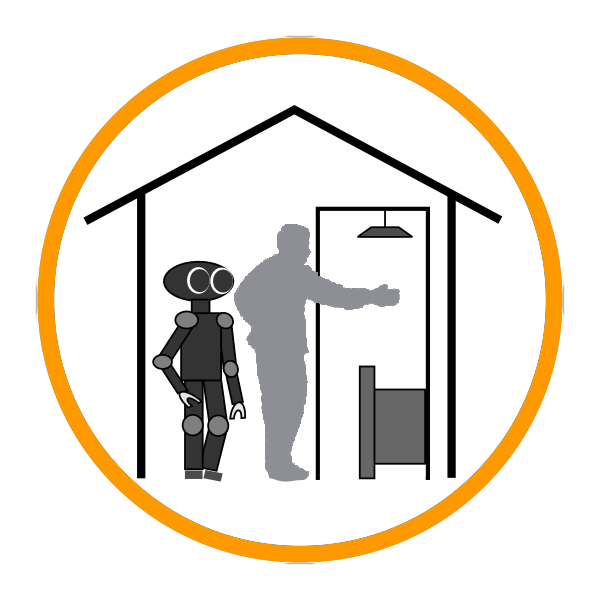
Scenario: A robot is shown
to the home environment
of its owner. Dialog between
the owner and the
robot defines the objects
and places, and disambiguates
interpretations.
This Key Experiment stresses
informational human-robot
interaction and the acquisition and learning of scenes and situations.
 |
.AVI |
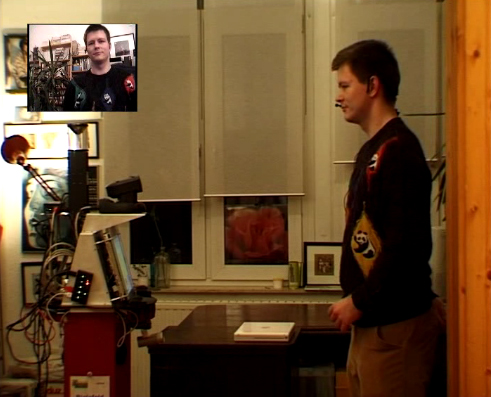
Home tour video [24.8 MB] (LAAS-CNRS) |
 KEY EXPERIMENT 2 - The Curious Robot (Top)
(lead partner: LAAS-CNRS)
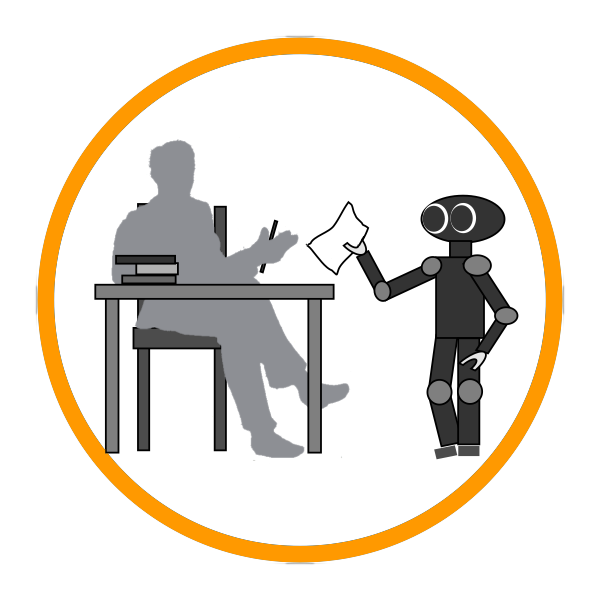
Scenario: A robot interprets a person's attitude and interacts with
him to understand his needs, then fetches a
requested object and hands it to
the person. Unknown objects
encountered by the robot
are modeled autonomously
and named by the person.
This Key Experiment
stresses object learning
and recognition, human
activity understanding, and
close physical human-robot interaction.
 .MPG
.MPGjido_boit_obst_above.mpg 837 ko (LAAS-CNRS)  .MPG
.MPGjido_boit_side.mpg 350 ko (LAAS-CNRS)  .MPG
.MPGjido-grasp-glass.mpg 856 ko (LAAS-CNRS)  .MPEG
.MPEGframe3.mpeg 1.5 MB (LAAS-CNRS)  .MPG
.MPGjoin2convobs.mpg 1.15 MB (LAAS-CNRS)  .MOV
.MOVmanip_nhp.mov 267 kb (LAAS-CNRS)  .MOV
.MOVrun1.mov 21.2 MB LAAS-CNRS)  .MOV
.MOVTrajectory_withNHP.mov 5.09 MB (LAAS-CNRS)  .MOV
.MOVTrajectory_withVSTP.mov 4.5 MB(LAAS-CNRS)  .AVI
.AVIVideoGrasping1.avi 18.4 MB (LAAS-CNRS)  .AVI
.AVIVideoGrasping2.avi 21 MB (LAAS-CNRS)
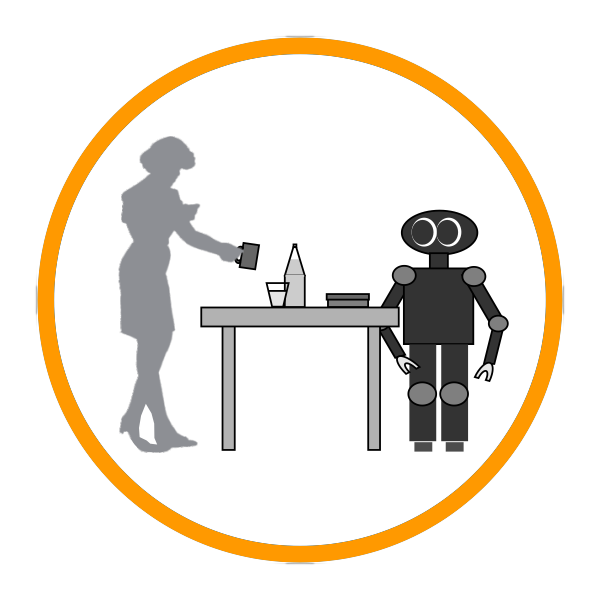 KEY EXPERIMENT 3 - Learning Skills and Tasks (Top)
(lead partner: University of Karlsruhe)
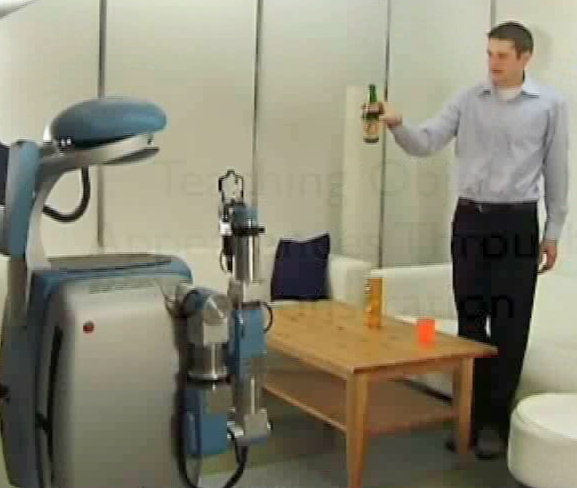
Scenario: A robot is shown by a person how to achieve a task such
as arranging objects on a table. The robot learns how to achieve this
task by imitating her, and reproduces
the task.
This Key Experiment stresses
task learning and reasoning
about tasks to acquire
knowledge about their goals
and achievements.
 .WMV
.WMVKE3_video .wmv (Univ. Karlsruhe / Fraunhofer IPA)